Every filter you install in a 13x18x4 slot cleans the air your family breathes for the next six to twelve months. That's enough time for pet dander, Florida humidity, and whatever drifted in during wildfire season to do their work. The call between a washable frame and a pleated disposable matters more than most buying guides let on. After manufacturing filters for over a decade and pulling used ones out of homes across the country, we know which type belongs in your slot and why.
A quick orientation before the buying decision. A 13x18x4 sits in a 4-inch deep cabinet, which changes the math on both washable and disposable types. If the slot itself is new territory, this primer on how to find filter slot placement will walk you through where yours lives. For the background on how any air filter captures particles, or a deeper look at air filter basics across sizes and formats, those references fill in the science. The buying decision starts below.
TL;DR Quick Answers
Which should I buy? A MERV 11 or MERV 13 pleated disposable, for most homes.
Why not washable? Low MERV capture, and in humid states they turn into a mold source if you reinstall them damp.
How long does a disposable last? 6 to 12 months in a 4-inch deep-pleat slot.
Best MERV? 11 for most homes. Step up to 13 if anyone has allergies, asthma, pets, or if wildfire smoke is a seasonal concern.
Biggest mistake? Buying on price alone and ignoring the MERV rating.
Top Takeaways
A 13x18x4 is a deep-pleat filter. Disposables use that depth for higher MERV and longer life. Washables don't.
Disposables beat washables on allergen, smoke, and fine-particle capture. It isn't close.
Washables are cheaper over five years, but only if you actually rinse and fully dry them every 30 days.
In humid climates, a washable frame reinstalled damp becomes a mold source inside the air handler.
For allergy, asthma, pet, or UV-light-equipped homes, pick a MERV 11–13 pleated disposable.
For any 4-inch deep-pleat slot, buy the exact nominal size and replace on schedule. That's where the real savings live.
What a 13x18x4 Air Filter Actually Is
The 13x18x4 is a deep-pleat filter built for HVAC cabinets with a 4-inch filter slot. The "13x18" is the nominal face size. Actual dimensions usually run slightly smaller, around 12.5 x 17.5 x 3.75 inches, to slide cleanly into the housing. If the size on your current filter doesn't match that standard, a quick filter size chart comparison against your unit's spec sheet will catch it. Here's why that extra depth matters: a 4-inch pleat packs far more filter media into the same face area than a 1-inch filter, so the whole thing runs longer, catches more, and puts less strain on your blower. You'll see the same engineering logic in another 4-inch size or a similar deep-pleat filter built for a different return opening.
Disposable 13x18x4 Filters
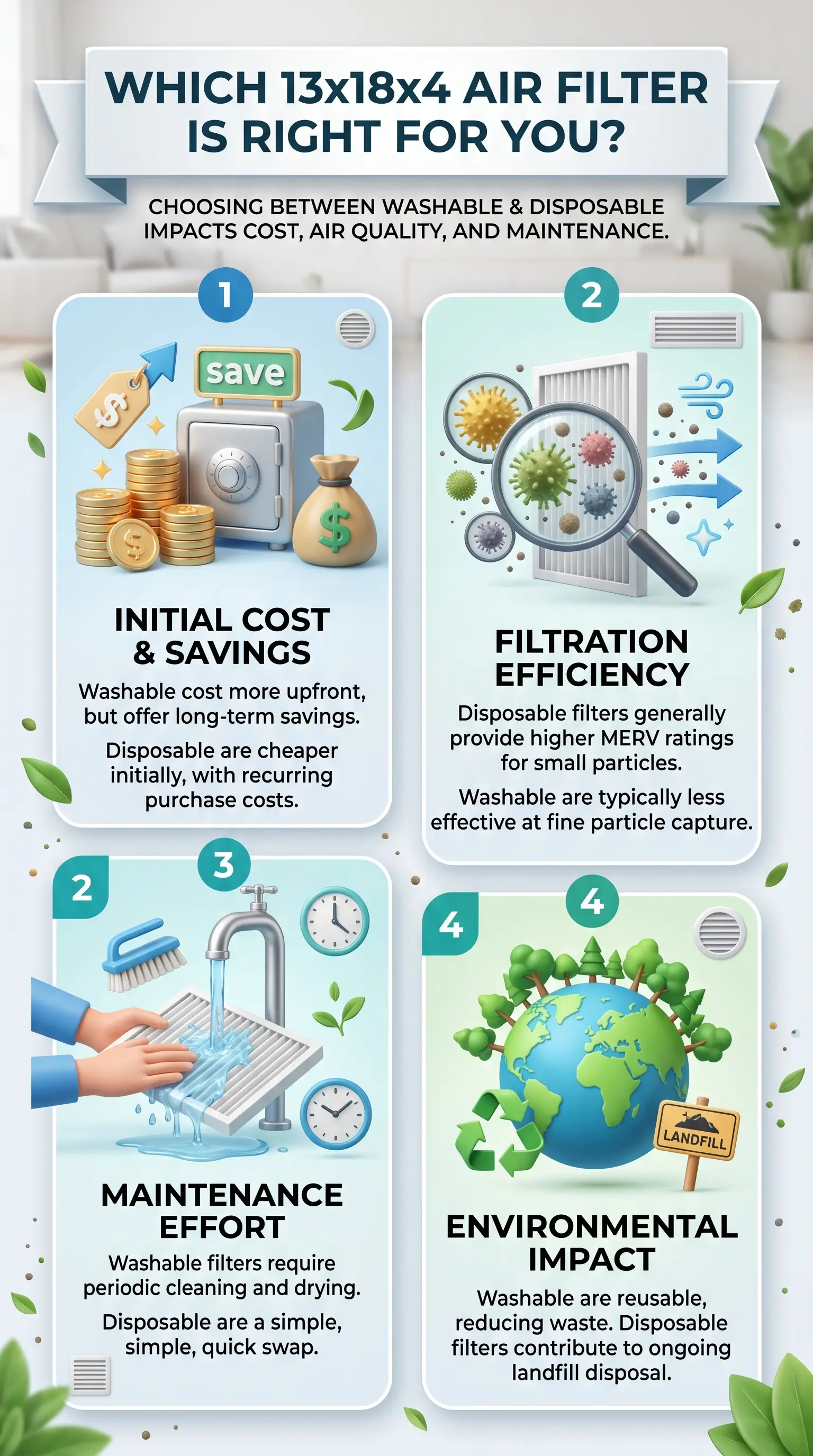
A disposable 13x18x4 is pleated synthetic media inside a cardboard frame. You install it, let it work for six to twelve months, and replace it. These filters come in a wide MERV range, most commonly MERV 8, 11, and 13. If you're not sure which level fits your household, this MERV rating guide walks through the capture power each rating delivers. In the slot, disposables trap small particles consistently, pull out cleanly without kicking dust back into the air, and don't need any maintenance between changes.
Trade-off: a recurring purchase, and the spent filter goes to landfill (though many brands now use recyclable frames).
Washable 13x18x4 Filters
A washable 13x18x4 uses an aluminum or polypropylene frame with electrostatic or foam media that you rinse, dry, and reinstall. One filter can last 5 to 10 years, and there are reusable filter options available across most common sizes if you want to price them. The appeal is straightforward: you pay once, and you generate less landfill waste over the life of the frame.
Trade-off: washable frames in a 4-inch depth typically sit in the MERV 1–4 range. That's fine for catching lint and larger dust, but not for allergens, smoke, or fine particulate. They also have to be fully dry before reinstalling. Any trapped moisture inside a Florida air handler becomes a mold invitation.
The Head-to-Head That Matters
Upfront cost first. A washable 13x18x4 usually runs $50 to $90 as a one-time buy. A quality disposable runs $25 to $55 per replacement. Stretch that out over five years and a home changing disposables twice a year spends roughly $250 to $550 on filters, while a washable owner pays the one-time frame cost and banks the rest in cleaning time and supplies.
Filtration is where the gap opens. Disposables win on MERV ceiling, allergen and dander capture, and wildfire smoke. For high-capture needs, stepping up to MERV 13 media makes a measurable difference inside the home. Washables capture dust and lint. That's it.
HVAC wear is the quiet one. A properly sized MERV 11 deep-pleat disposable moves air well for 6 to 12 months with no drama. If your system only accepts a thinner slot, a 1-inch MERV 8 replacement or a 2-inch filter option is the right fit instead. A washable loaded with dust, or one installed damp, raises static pressure and makes your blower work harder than it should. Your electric bill feels it. Your blower motor feels it longer.
Which One Should You Buy?
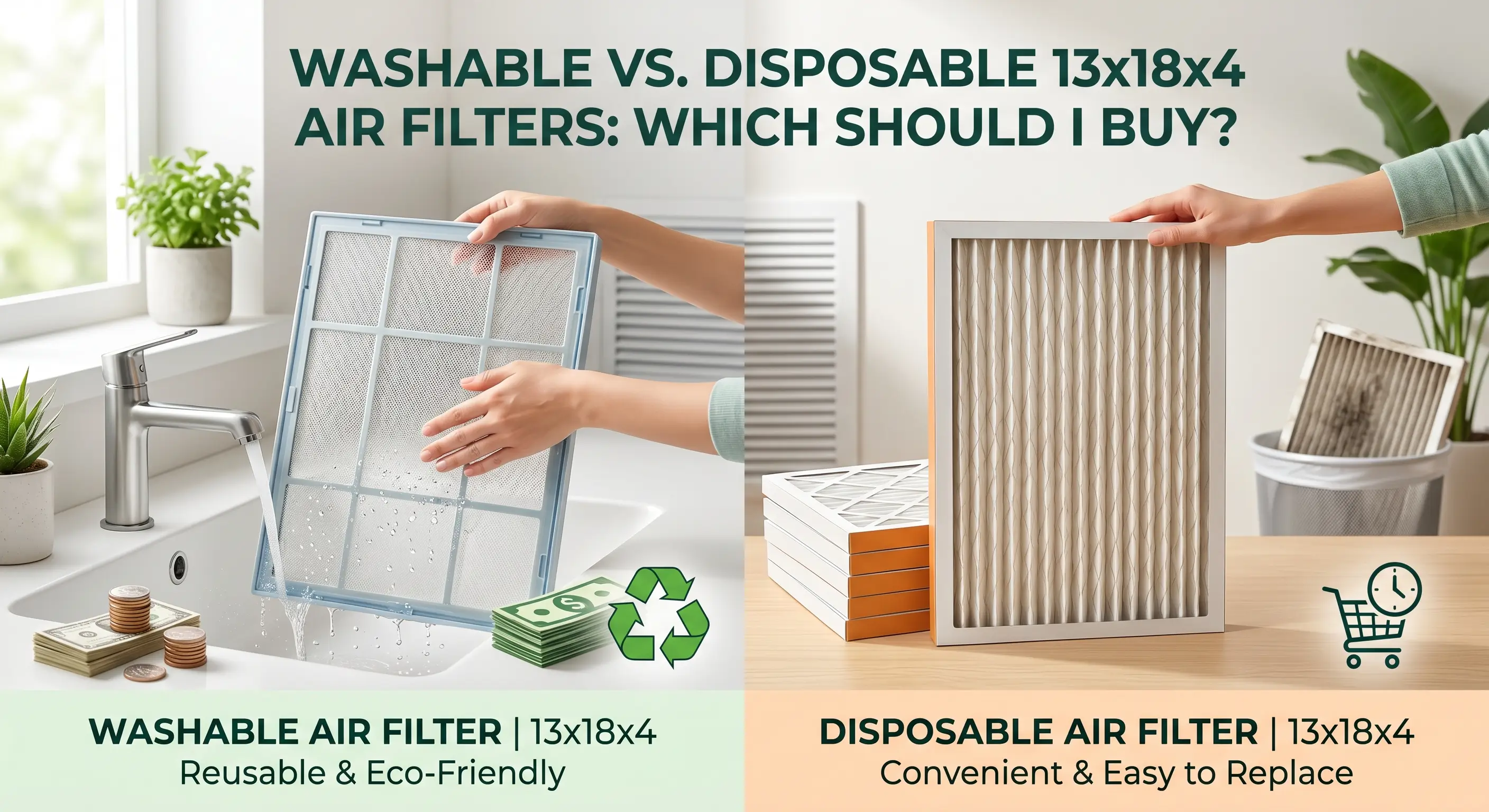
Pick a disposable if anyone in the house has allergies. An allergen defense pleats model is a solid baseline. With pets in the home, an odor eliminator filter handles dander and household odor at the same time. If you run a UV light in your HVAC, read up on the UV system tradeoffs before you commit. And if you live somewhere humid like South Florida, the mold risk alone makes a disposable the safer call. A washable makes sense when you prioritize lowest long-term cost, nobody in the home has sensitivities, and you'll actually clean it every 30 days. For most families, a high-quality MERV 11 disposable is the call. You can shop premium 13x18x4 air filters online in the exact size and MERV your system needs.
"In our own testing of 13x18x4 filters pulled from Florida air handlers, washable frames lost their edge every time indoor humidity stayed above 60 percent, because homeowners kept reinstalling them before the frame fully dried, and mold took hold inside the handler. A MERV 11 pleated disposable changed every six months has been the quieter, healthier call in this climate for years running."
— Filterbuy Air Quality Team
7 Essential Resources
Every resource below is a primary authority on air quality, filtration, or home energy. All are non-commercial, non-competitor, and each lives on a unique domain.
EPA — The Inside Story: A Guide to Indoor Air Quality. The foundational U.S. government reference on indoor pollutants and how filtration fits in. epa.gov
ASHRAE — Filtration & Air Cleaning Position Document. The engineering body behind the MERV standard (ASHRAE 52.2) that classifies filter efficiency. ashrae.org
ENERGY STAR — Heat & Cool Efficiently. EPA's guidance on filter replacement frequency and how dirty filters waste energy. energystar.gov
CPSC — The Inside Story: A Guide to Indoor Air Quality. Consumer Product Safety Commission's co-authored guide to home air quality hazards. cpsc.gov
American Lung Association — Indoor Air Pollutants and Health. Respiratory-health perspective on the particles your filter is actually catching. lung.org
CDC NIOSH — Indoor Environmental Quality. The CDC's occupational-health arm on ventilation, filtration, and pollutant exposure. cdc.gov
NIEHS (NIH) — Indoor Air Quality. The National Institutes of Health on the health research behind indoor air. niehs.nih.gov
3 Statistics
90% — Americans spend approximately 90 percent of their time indoors, where the air your filter is cleaning is the air you actually breathe all day. Source: U.S. EPA. epa.gov/report-environment/indoor-air-quality
2–5x — Concentrations of some indoor pollutants are often 2 to 5 times higher than typical outdoor levels. This is the reason to step up to a higher-MERV pleated filter. Source: U.S. EPA. epa.gov/report-environment/indoor-air-quality
Nearly 50% — Nearly half of the energy used in a typical U.S. home goes to heating and cooling. A clogged or undersized filter forces the system to work harder and directly inflates that bill. Source: ENERGY STAR (U.S. EPA/DOE). energystar.gov/saveathome/heating-cooling
Final Thoughts and Opinion
The washable-vs-disposable debate gets flattened online. Writers frame it as eco-friendly reusable versus wasteful throwaway, and that framing skips the part that actually matters: what happens inside your HVAC once the filter is installed.
A 13x18x4 is a deep-pleat slot. That slot exists because homeowners want less frequent replacements and better filtration at the same time. A washable filter in that slot gives up most of the capture advantage the 4-inch depth was built to deliver. You end up with a frame that catches lint and large dust, not the fine particulate that matters: dander, smoke, pollen fragments, and mold spores. Those are what affect your family's breathing, and they're the reason the invisible part of indoor air is the part worth paying attention to.
Our opinion, formed from the filters we've actually made and tested: for the vast majority of homes with a 4-inch slot, a MERV 11 or MERV 13 pleated disposable is the right call. If you want to price-check before ordering, an alternate retailer option and another marketplace listing both carry the same product. That disposable is the choice that protects your family, your HVAC system, and your energy bill at the same time. Save the washable conversation for single-slot workshop ventilation or a vacation cabin where nobody has allergies.
Frequently Asked Questions
Can a washable filter replace a disposable 13x18x4?
Physically, yes. A washable frame in the 13x18x4 size will slide into the same slot. Functionally, no. A washable typically rates MERV 1–4 and won't capture allergens, smoke, or fine particulate the way a MERV 11–13 pleated disposable will. Same opening, very different air quality outcome.
What MERV rating is best for a 13x18x4 air filter?
MERV 11 is the sweet spot for most homes. It gives you strong allergen and dust capture without restricting airflow. Step up to MERV 13 if anyone has asthma, allergies, or if wildfire smoke is a seasonal concern. Avoid MERV 16 unless your HVAC was specifically designed for it.
Do washable filters restrict airflow more than pleated disposables?
They can. A dust-loaded washable or a foam-media model has higher static pressure than a fresh deep-pleat disposable. That forces your blower to work harder, which shows up on the electric bill and shortens motor life.
How often should I change a disposable 13x18x4?
Every 6 to 12 months is typical because of the deep-pleat surface area. Shorten that window if you have pets, burn candles, do renovations, live near construction or wildfire zones, or run the HVAC 24/7 in peak summer.
Is a 13x18x4 the same as a 13.5x18.5x4 filter?
Close, but not identical. 13x18x4 is the nominal size. Actual dimensions are typically around 12.5 x 17.5 x 3.75 inches. A filter sold as 13.5x18.5x4 is a different nominal size. Other different size options follow the same nominal-vs-actual rule. Always match the size printed on your current filter or stamped inside the slot.
You're the protector of the air everyone in your house breathes.
Measure your slot one more time, confirm the MERV your household needs, and then order USA-made 13x18x4 air filters direct from Filterbuy. Cleaner air starts with the right filter in the right slot, and you just did the homework to pick it.
Learn more about HVAC Care from one of our HVAC solutions branches…
Filterbuy HVAC Solutions - Miami FL - Air Conditioning Service
1300 S Miami Ave Apt 4806 Miami FL 33130
(305) 306-5027
https://maps.app.goo.gl/Ci1vrL596LhvXKU79